
We are influencers and brand affiliates. This post contains affiliate links, most which go to Amazon and are Geo-Affiliate links to nearest Amazon store.

In school we are always taught that the speed of light is the universal limit. No object with mass can travel at the speed of light because the amount of energy required would be infinite.
On top of that, traveling at the speed of light, or hypothetically exceeding it, would create major logical problems, such as violations of the principle of causality. In theory, if something could exceed the speed of light, strange effects could occur, like an effect happening before its cause, which would break the laws of physics.
However, there are two ways to “cheat” the speed of light: one based on a mathematical solution proposed by Albert Einstein, and another based on an idea created by Mexican physicist Miguel Alcubierre, inspired by Star Trek.
Wormholes: A Solution to Einstein’s Equations
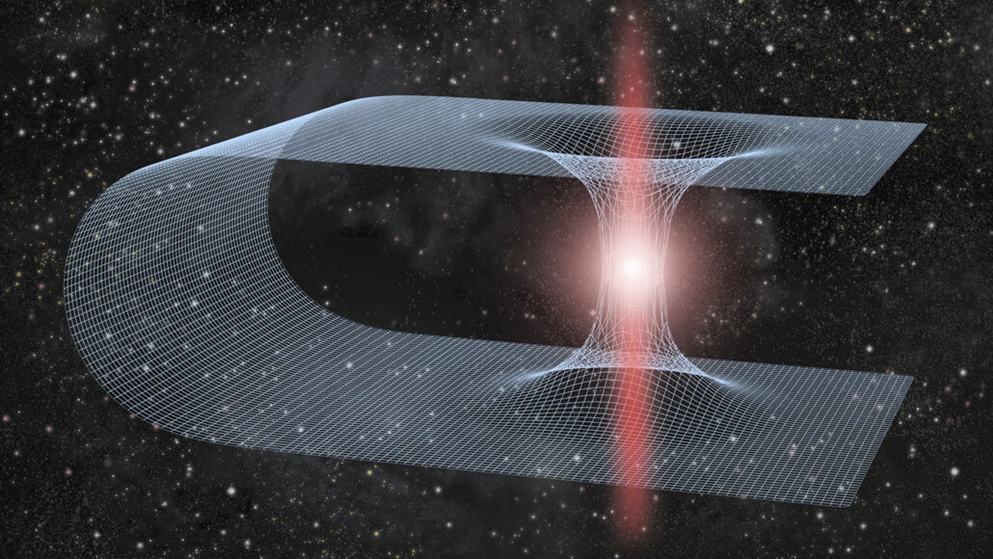
Wormholes are solutions to the equations of general relativity. They can be difficult to imagine because they would allow very strange things to happen in the universe. However, if we could use them, they could theoretically shorten distances enormously. Instead of traveling through space the way we do today, tunnels could connect extremely distant regions of space, allowing a journey of hundreds of light years to take seconds, minutes, days, weeks, months, or years. We simply do not know.
Even though they appear as mathematical solutions to Albert Einstein’s equations, we do not know whether wormholes can actually exist, much less how to create one. Physics does not forbid them. There is no known law of physics that rules them out. Still, they may simply not exist or could be impossible to create artificially.
The Alcubierre Metric
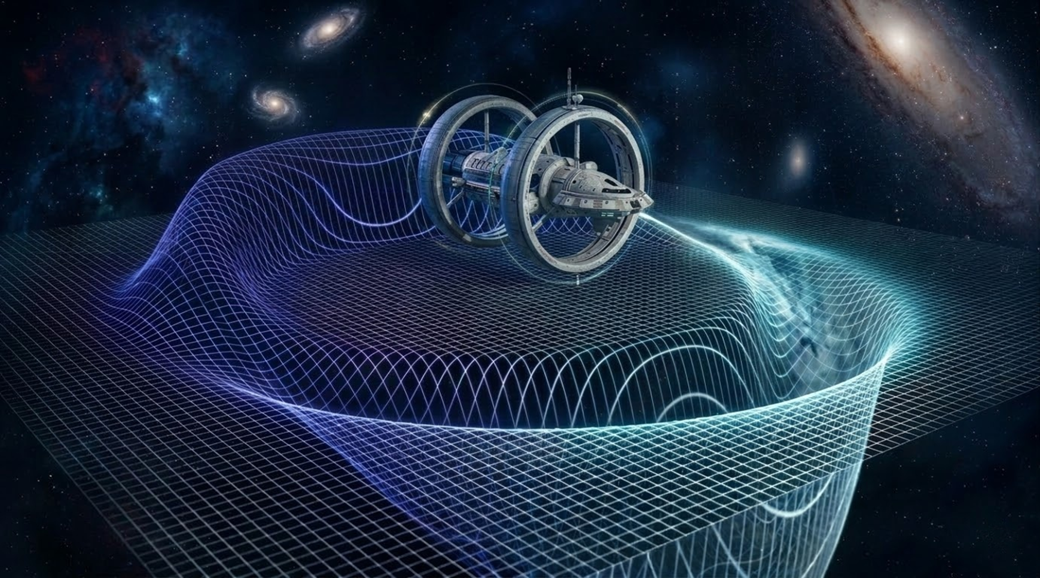
Even though nothing can travel faster than light, there is something that can expand faster than light: space itself. For example, the space between galaxies expands exponentially, and at large enough distances that expansion exceeds the speed of light.
Because of this, the Alcubierre metric, first proposed in a 1994 paper, suggests taking advantage of this unusual property of space using a spacecraft surrounded by a special bubble. This mathematical idea is commonly known as a “warp drive.”
In this hypothetical form of travel, space in front of the spacecraft would be compressed while space behind it would expand. In other words, the spacecraft itself would not be moving through space. Instead, the space around it would be moving.
Interestingly, the Alcubierre metric was inspired by Star Trek, as Miguel Alcubierre himself has mentioned. However, even though physics does not forbid the idea, it faces major problems similar to those of wormholes.
What Do Wormholes and Warp Drives Have in Common?
Besides the fact that we have no idea how to create them, both concepts would require exotic energy, also known as negative energy. In one of his lectures, Miguel Alcubierre told the audience that this problem might not sound strange to people unfamiliar with physics, so he gave a simple analogy: when he goes to the supermarket, he never asks for minus two kilograms of tortillas.
Exotic energy, or negative energy, is so unusual that there is currently no evidence it can exist in large amounts, although some effects in quantum physics suggest tiny quantities might exist. Once again, physics does not forbid it.
Will we one day travel so fast that we could visit other planetary systems and return before dinner?
I would love to answer that question. It is a fascinating one. But the honest answer is that I do not know, and at the moment, no one else does either. Still, there is a reason to be optimistic. Technology and science advance extremely fast. Just a little over 120 years ago, many people believed flying in an airplane was impossible, and today it is completely normal.
We are influencers and brand affiliates. This post contains affiliate links, most which go to Amazon and are Geo-Affiliate links to nearest Amazon store.

My name is Joel! I love to read, I go to university like most people my age.
In my free time I usually train boxing, I love music, I also know how to play the guitar and the harmonica.