
We are influencers and brand affiliates. This post contains affiliate links, most which go to Amazon and are Geo-Affiliate links to nearest Amazon store.
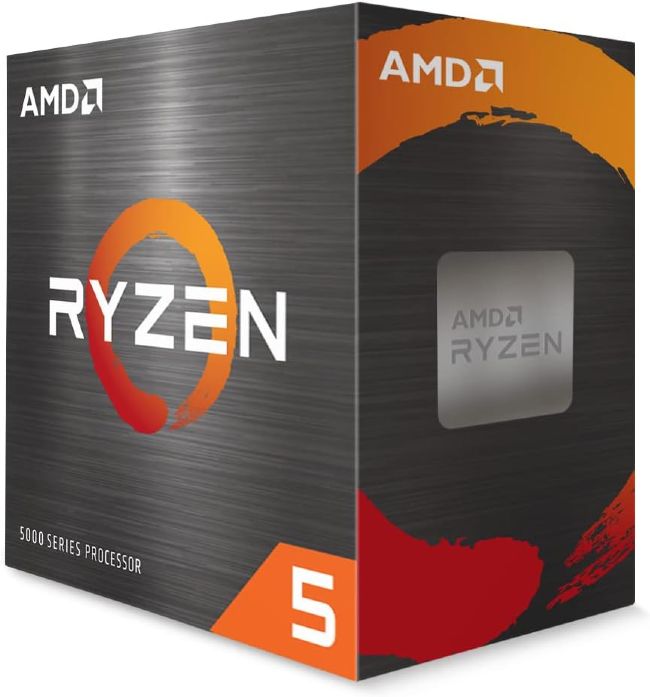
The Ryzen 5 5500 is definitely one of the best processors in terms of value for money. If you are interested in it, chances are you are planning to build your own gaming PC. It is usually available for under $100 most of the time and can even drop below $80 during good sales.
So, this is an entry-level processor, but still a very capable one, especially for graphics cards with performance similar to or up to an RTX 5050. That said, there are a few important things to keep in mind because many people overlook the fact that even though this is a relatively recent processor and part of AMD’s successful Ryzen 5000 series, it does have some limitations.
It is a 6-core, 12-thread processor that handles multitasking efficiently and is more than capable for gaming. Just keep in mind that it is best paired with a graphics card comparable to an RTX 5050 or an AMD Radeon RX 7600 as a practical upper limit. Anything significantly more powerful may lead to the well-known bottleneck effect that can limit GPU performance.
The most important thing to mention is that this processor is designed to operate on PCIe 3.0. That means even if you install it in a motherboard that supports PCIe 4.0, the processor will limit the connection to PCIe 3.0. This is not a major issue if your main concern is gaming performance, since we are usually talking about performance differences of around 3% at most in many tests, which is not very significant.
However, it is worth understanding that PCIe 4.0 offers up to 64 GB/s of bidirectional bandwidth compared to 32 GB/s on PCIe 3.0. In other words, PCIe 4.0 doubles the available bandwidth. Normally this is not a problem, but differences can appear when the GPU frequently needs to request data from the CPU or storage instead of relying mainly on its VRAM.
For example, I own a Radeon RX 6400, which is a relatively limited graphics card. In testing, I have seen differences of up to 15%, although updates eventually improved performance somewhat when using PCIe 3.0. But as mentioned earlier, with cards like the Nvidia RTX 5050, the difference is almost nonexistent regardless of whether the card is running on PCIe 3.0 or PCIe 4.0.
I mention this because the second most popular alternative is the AMD Ryzen 5 5600, which often costs around $150. If we compare that to the average price of around $80 for the AMD Ryzen 5 5500, the difference is roughly $70.
If you ask me, I would say that in most situations the upgrade is not really worth the extra cost unless you plan to use something like an RTX 5070 or another significantly more powerful graphics card. The Ryzen 5 5500 remains an excellent value option for people working with tighter budgets.
That said, if you find the Ryzen 5 5600 at a good price and you are thinking about upgrading to a more powerful GPU in the future, it may end up being the smarter long-term purchase.
We are influencers and brand affiliates. This post contains affiliate links, most which go to Amazon and are Geo-Affiliate links to nearest Amazon store.

My name is Joel! I love to read, I go to university like most people my age.
In my free time I usually train boxing, I love music, I also know how to play the guitar and the harmonica.