
We are influencers and brand affiliates. This post contains affiliate links, most which go to Amazon and are Geo-Affiliate links to nearest Amazon store.
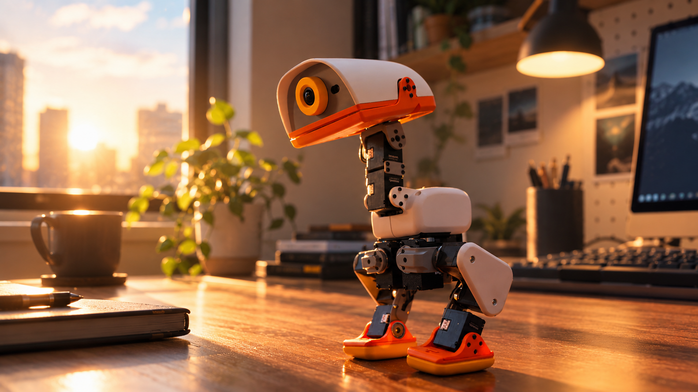
Recently, NVIDIA introduced MicroDuck, developed by Pollen Robotics and Hugging Face. It is a small, duck-shaped robot that looks adorable at first glance, and I have to admit, it really is. However, beyond the robot itself, what I find most interesting is how it was trained.
MicroDuck can perform several basic tasks, such as walking, picking up objects like clothes with its mouth, skating, and even doing some funny flips.
Once again, the interesting part here is the technology behind it. Instead of programming every movement in advance, as was traditionally done with this type of robot, NVIDIA's technology was used to train it through massive simulations where it learns to control its own movements.
In other words, what we humans call reinforcement learning is being applied in a very similar way with MicroDuck. This significantly changes how robots can be trained and opens up the possibility of more people developing their own robotics projects and eventually scaling them up thanks to access to these new technologies.
The two main technologies used were NVIDIA Isaac Lab and NVIDIA Isaac Sim. Isaac Sim allows developers to create the virtual environment where the robot practices, while Isaac Lab handles training its movements through reinforcement learning. This way, the robot can learn in a simulated environment before applying what it has learned to the real world.
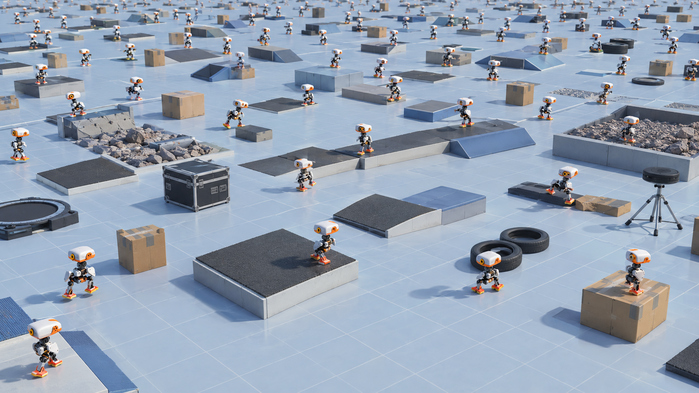
In this image, you can get a much better idea of what I am trying to explain. The robot receives information that is stored as it learns exactly what to do in specific situations. For example, realistic scenarios are generated where the robot learns to walk, stay upright if it trips, and even develop additional skills.
Once the robot learns these skills through simulation, it can transfer them to the real world. There is no need to manually program or calculate every movement because the technology NVIDIA provides does the heavy lifting. This is how the robot can use artificial intelligence to respond to situations it has been trained to handle beforehand.
The really cool thing is that MicroDuck can actually be trained by users. It is not just a robot with a limited set of abilities. As I explained earlier, it can be trained to develop new skills.
How much does MicroDuck cost?
The current preorders price is $399. However, based on what I have read on the website, new preorders may take up to six months to arrive. Demand surged after Jensen Huang, NVIDIA's CEO, presented the robot on October 21, 2026.
So once again, in my opinion, MicroDuck itself is not the truly revolutionary part. It is the technology that makes it possible to train the robot. I think what makes this interesting is seeing its potential and keeping an eye on the progress of other robotics companies to discover just how much these technologies can improve.
I genuinely expect to see major changes in robotics over the next 5 to 10 years. Companies are making rapid progress, although I still feel that we do not yet have truly intelligent robots that can operate independently without humans having to constantly supervise them. That is precisely the level I would love to see us reach someday.
We are influencers and brand affiliates. This post contains affiliate links, most which go to Amazon and are Geo-Affiliate links to nearest Amazon store.

My name is Joel! I love to read, I go to university like most people my age.
In my free time I usually train boxing, I love music, I also know how to play the guitar and the harmonica.